The Bifrost
A timber arch that holds itself up through interlocking friction alone — no fasteners at the crossing joints, covered with tarp or greenhouse film for a carport, hoop house, or covered patio.
Why the name
Named for the Bifröst, the rainbow bridge of Norse mythology connecting Asgard to Midgard — an arch that holds together under its own internal logic rather than an external frame, the same principle behind this build's crossing, load-locking joints.
A self-supporting timber arch built from paired logs that cross and notch against each other in sequence — the same interlocking logic as a Leonardo da Vinci self-supporting bridge, bent into an arch instead of a flat span. No fasteners are required at the crossing joints; friction and load-locking hold it rigid. Covered with tarp or greenhouse film, it functions as an open-ended carport, hoop-house-style greenhouse, or covered patio depending on scale and cladding.
Example Applications
- Vehicle/van carport.
- Hoop-house-style covered patio.
- Open-air covered seating structure.
First CAD Pass (2026-09-13)
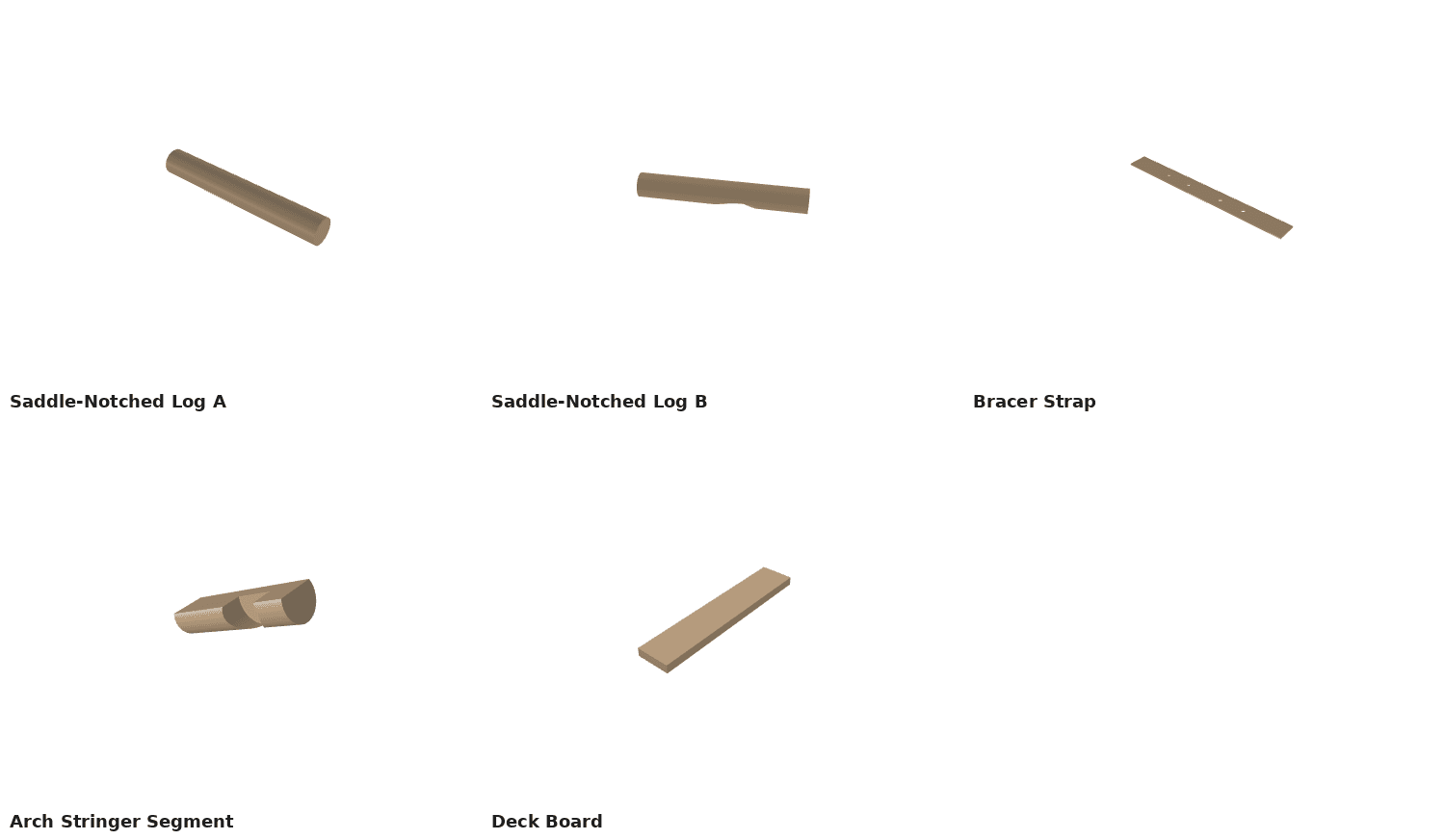
Real geometry now exists for the saddle-notch joint itself (a concave seat cut to match the mating log's own curvature, so two logs bear on each other across a full contact surface instead of a thin line — the same reason a saddle notch beats a flat notch in traditional log-cabin corners) plus a bracer strap for redundancy, and a chained stringer using the same joint to build a full multi-segment arch span. Log diameter (7") and notch depth (40% of diameter, leaving 60% of the log's cross-section intact) are real, deliberate values — worked out for maximum contact surface area, not a guess — but still not a certified structural calculation for a specific species/span/load combination. Cut this notch in scrap material and load-test it before trusting it under a covered arch with real snow or wind load.
Open Items
- Log diameter and 40% notch-depth ratio are real, deliberate values — still need scrap-material dry-fit and load testing before trusting them under real snow/wind load, not a certified calc yet
- The full-arch stringer's ground-bearing ends are placeholder flat-cuts, not yet tied into the Ogopogo connector standard