For Seekers
Common Ground
Every religion swears it has the answer. Nobody agrees on the question — and that's the interesting part.
The major traditions keep landing on the same underlying observation, over and over, with no contact between them — they just say it in different accents, and everybody forgot they're related. Common Ground reads them side by side, in plain language, from an ordinary guy in a West Virginia holler who couldn't leave the question alone.
Second page
Reading Systems
Tarot, astrology, runes, numerology, and more — pattern-reading tools, not world religions.
New
Scripture Lookup
Type a reference — "John 3:16" — pull up the passage, and (as the index grows) similar passages from other traditions.
Study Guide Library
35 guidesCommon Ground Verified — pulled from the reviewed study-guide library (kb-build review pass, 2026-08-20). Not yet seeded to Supabase; this is the repo's own data until that migration happens.
African Traditional Religions
Reference study guide to African Traditional Religions (ATRs) covering four traditions in depth — Yoruba, Akan, Bantu, and Dogon — plus their diaspora descendants (Candomblé, Santería, Haitian Vodou). Centers on shared structural features: a distant supreme being, intermediary divine powers, active ancestor veneration, vital force (ashe/nyama/ntú), and community as the primary spiritual unit.
Bhagavad Gita
Chapter-by-chapter study guide to all 18 chapters of the Bhagavad Gita, tracing Arjuna's crisis on the battlefield of Kurukshetra through Krishna's teachings on duty, selfless action (karma yoga), devotion (bhakti), meditation, and the cosmic vision of the divine.
Celtic Mythology
Study guide to Celtic mythology spanning Irish, Welsh, and continental traditions — organized around the Otherworld as a parallel realm accessible through liminal places, the Tuatha Dé Danann pantheon, the Ulster and Fenian heroic cycles, and the Mabinogion's Welsh mythology, including the Celtic roots of the Arthurian and Grail traditions.
Dante — The Divine Comedy
Study guide to Dante's Divine Comedy (composed c. 1308–1320): 100 cantos across Inferno, Purgatorio, and Paradiso, structured around contrapasso, the guides Virgil and Beatrice, and love in three states (disordered, being corrected, rightly ordered).
Dhammapada
Study guide to all 26 chapters and 423 verses of the Dhammapada, the widely-read Pali Canon collection of the Buddha's ethical teachings on mind, heedfulness, craving, anger, and the path to liberation.
Egyptian Mythology
Study guide to Egyptian religion across roughly 3100 BCE-400 CE, organized around Ma'at (truth, justice, cosmic order) as the tradition's central concept, covering the multiple creation myths, the Osiris-Isis-Horus-Set cycle, the major deities, and the afterlife theology of the Duat, weighing of the heart, and Book of the Dead.
Gnostic Sacred Texts
Dense reference guide to Gnostic Christian scripture organized into five collections (Pistis Sophia, Nag Hammadi cosmogony texts, hidden gospels, wisdom/revelation texts, Thomasine/Sethian texts, plus ethics texts), covering Gnostic cosmology (Pleroma, Demiurge, Archons, Sophia's fall) and the path to gnosis.
Greek Mythology
Dense reference guide to Greek religion and mythology: orthopraxic ritual religion with no canon/clergy, Hesiod's Theogony/Five Ages, the Twelve Olympians, the great myths (Iliad, Odyssey, Prometheus, Oedipus), the hero tradition, and the mystery traditions (Eleusinian Mysteries, Orphism, Pythagoreanism) linking to Plotinus.
Hindu Mythology
Dense reference guide to Hindu mythology as the narrative complement to the Bhagavad Gita and Upanishads: the Trimurti, the Devi/goddess traditions (Mahadevi, Durga, Kali, Parvati/Lakshmi/Saraswati), the ten-avatar Dashavatara doctrine, and the Ramayana/Mahabharata epics.
Homer — The Iliad and The Odyssey
Study guide covering both Homeric epics: the Iliad (15,693 lines, the rage of Achilles across the final weeks of the Trojan War's tenth year) and the Odyssey (12,110 lines, Odysseus's ten-year, non-linear journey home to Ithaca), both in dactylic hexameter with shared oral-formulaic epithets.
I Ching
Dense reference guide to the I Ching (Classic of Changes, core text ~1000 BCE, Ten Wings commentary ~400-200 BCE): system mechanics (yin/yang, trigrams, hexagrams, consultation methods), philosophical framework, key individual hexagrams, core themes of timing and position, and translation guidance.
Kabbalah
Dense reference guide to Kabbalah organized around the Tree of Life's ten Sefirot (Keter through Malkhut) and six core texts (Sefer Yetzirah, Sefer HaBahir, the Zohar, Etz Chaim, Tanya, Gate of Light), spanning ancient Merkavah mysticism through Lurianic Kabbalah to Hasidic psychology.
Meditations (Marcus Aurelius)
Dense reference guide to Marcus Aurelius's Meditations, private Stoic notebooks written c. 161-180 CE and never intended for publication, covering all twelve books individually and the core Stoic vocabulary underlying them.
Mesoamerican Mythology Study Guide
Covers Maya and Aztec religious traditions as related but distinct systems surviving mainly through post-conquest colonial-era texts (Popol Vuh, Florentine Codex). Shared framework: layered cosmos, 260-day ritual calendar, cyclical world-ages, feathered serpent deity, and blood as cosmic maintenance. Maya section centers the Popol Vuh's creation account and the Hero Twins' defeat of the Xibalba death lords; Aztec section covers the Five Suns creation cycle, Quetzalcoatl/Tezcatlipoca cosmic conflict, the major pantheon (Huitzilopochtli, Tlaloc, Coatlicue, Xipe Totec, Mictlantecuhtli), the theology of human sacrifice as cosmic debt repayment, bloodletting/auto-sacrifice, and the 3,500-year-old Mesoamerican ball game.
Mesopotamian Mythology Study Guide
Covers the Sumerian/Akkadian/Babylonian mythological tradition (~3500-539 BCE) as the world's oldest surviving literary corpus, preserved on fired clay tablets. Centers the Enuma Elish creation epic (Tiamat, Marduk), the Epic of Gilgamesh (friendship with Enkidu, the flood narrative in Tablet XI, Utnapishtim, and Siduri's counsel as the tradition's answer to mortality), the major pantheon (Anu/Enlil/Enki, Inanna/Ishtar, Shamash/Nanna/Nergal), and the Descent of Inanna as the oldest death-and-resurrection narrative in world literature. Extensive documented parallels to the Hebrew Bible (flood, creation, wisdom literature) are treated as established literary influence, not speculative.
Native American Religion Study Guide
Covers five specific traditions within the ~500+ distinct Native American nations: Lakota (Wakan Tanka, the Sacred Hoop, White Buffalo Calf Woman and the Seven Sacred Rites, the vision quest/Hanbleciya), Haudenosaunee (Sky Woman creation, Turtle Island, the Great Law of Peace/Gayanashagowa), Diné/Navajo (Hózhó and the Blessingway) and Anishinaabe (Manidoo, the Seven Grandfather Teachings), Pacific Northwest (Raven as trickster-creator, the potlatch), and the cross-national trickster tradition (Coyote, Iktomi, Nanabozho). The guide explicitly frames itself as deliberately incomplete, withholding sacred/restricted knowledge that indigenous communities have asked to be kept within their communities, and foregrounds land/place-specificity as the tradition's defining theological difference from portable Eurasian scriptural traditions.
New Testament Study Guide
Covers the 27-book New Testament canon (Koine Greek, written ~50-100 CE, canon finalized at the Council of Carthage 397 CE) in order of composition rather than canonical order: Paul's letters first (50s-60s CE), then Mark (~70 CE), Matthew and Luke/Acts (~85 CE), John (~90-100 CE), Revelation (~95 CE). Covers each Gospel's distinct theological character (Mark's urgency, Matthew's Jewish/Mosaic framing and Sermon on the Mount, Luke's concern for outsiders and Acts' account of the early church, John's Logos theology), Paul's major letters (Romans, 1 Corinthians, Galatians, Philippians, Philemon), Hebrews and James, and Revelation as first-century coded apocalyptic resistance literature rather than prediction of modern events.
Norse Mythology Study Guide
Covers pre-Christian Norse/Germanic mythology as preserved almost entirely through 13th-century Icelandic Christian sources (Snorri Sturluson's Prose Edda, ~1220 CE, and the anonymous Poetic Edda, compiled ~1270 CE). Centers Yggdrasil and the nine worlds, the Ymir creation myth, the major Aesir/Vanir deities (Odin, Thor, Loki, Freya, Tyr), the great myths (the Mead of Poetry, the Binding of Fenrir, the Death of Baldr), Ragnarok as a foreknown and unavoidable doom for the gods, and the Hávamál wisdom literature. Framed as the library's most distinctive tradition for offering no cosmic guarantee that good prevails — its central ethical teaching is courage and dignity in the face of known, inevitable defeat.
Old Testament Study Guide
Covers everything after the Torah in the Hebrew Bible/Christian Old Testament: the Historical Books (Joshua through Esther/Maccabees, ~800 years from the conquest of Canaan through the Persian period), the Wisdom and Poetry books (Job, Psalms, Proverbs, Ecclesiastes, Song of Solomon), and the Major (Isaiah, Jeremiah/Lamentations, Ezekiel, Daniel) and Minor Prophets (the Twelve, Hosea through Malachi). Organized around the Tanakh's three-part structure (Torah/Nevi'im/Ketuvim) and framed by the central question of why Israel ended up in exile and what that means for the covenant.
Plato — The Republic
Study guide to Plato's Republic (composed c. 375 BCE, 10 books, dialogue set in Piraeus over one evening): the question of justice, built up via an ideal city, the tripartite soul, and the Sun/Line/Cave analogies.
Quran Study Guide
Covers the Quran's structure (114 Surahs arranged roughly by length rather than chronology, spanning Meccan 610-622 CE and Medinan 622-632 CE revelation periods), the Islamic doctrine of the Quran as literal divine speech (Kalam Allah) transmitted through Muhammad, and representative Surahs across the revelation timeline: Al-Fatiha (the opening prayer), early Meccan material (Al-Alaq/first revelation, Al-Ikhlas/pure monotheism, Al-Asr, Al-Duha), middle Meccan prophetic narratives and the 99 divine names, late Meccan material (the Night Journey, Surah Al-Kahf), and Medinan legal/social material (Al-Baqarah, Al-Imran/Al-Nisa, the contested warfare verses, Al-Hujurat's social ethics, Al-Rahman's poetic structure).
Sophocles — Oedipus Rex
Study guide to Sophocles's Oedipus Rex (composed c. 429 BCE, single-act tragedy set in Thebes over one day): a plague-driven murder investigation in which the king discovers he is both detective and killer.
Sufism Study Guide
Covers Sufism (tasawwuf) as the interior/mystical dimension of Islam, structured around the Islam-Iman-Ihsan three-level framework from Hadith Jibril. Covers the maqamat (stations, earned through effort) and ahwal (states, given as grace) spiritual-psychology map, the fana/baqa (ego-annihilation/subsistence) goal, major figures (Rabia al-Adawiyya, Al-Hallaj, Al-Ghazali, Rumi, Ibn Arabi), core practices (dhikr, sama/whirling, the murshid-murid teacher-student bond, the tariqa orders), foundational texts (Rumi's Masnavi, Ibn Arabi's Fusus al-Hikam, Attar's Conference of the Birds, Al-Qushayri's Risala), and Sufism's contemporary tension with Salafi/Wahhabi Islam.
Talmud Study Guide
Covers the Talmud's two-layer structure (Mishnah, compiled ~200 CE by Rabbi Judah HaNasi, and Gemara, compiled into Babylonian ~500 CE and Jerusalem ~400 CE versions) across its six Orders (Zeraim/Seeds, Moed/Appointed Times, Nashim/Women, Nezikin/Damages, Kodashim/Holy Things, Tahorot/Purities; 63 tractates, 2,711 pages in the standard Vilna edition). Highlights key tractates (Berakhot, Shabbat, Pesachim, Yoma, Kiddushin, Gittin, the Bava tractates, Sanhedrin, Avot/Ethics of the Fathers, Niddah) and foundational Aggadic (narrative/theological) material, including the Oven of Akhnai story and the Hillel-Shammai disputes, illustrating the Talmud's methodological commitment to preserving minority/losing legal opinions alongside binding rulings.
Tao Te Ching
Study guide to the Tao Te Ching (81 chapters attributed to Laozi, ~4th century BCE or earlier), covering the Tao, Te, wu wei, the uncarved block, reversal/paradox, leadership, and the text's teaching on death and contentment.
The Analects
Study guide to Confucius's Analects (Lunyu), a compilation of his sayings and dialogues with disciples assembled after his death. Organizes the text around core concepts — ren (humaneness), li (ritual propriety), the junzi (exemplary person) ideal, learning (xue), and virtue-based governance.
The Diamond Sutra
Study guide to the Diamond Sutra (Vajracchedika Prajnaparamita Sutra), a Mahayana Buddhist dialogue between the Buddha and his disciple Subhuti that uses a recurring three-part formula (X is not X, therefore it is called X) to dismantle clinging to fixed concepts, including Buddhist concepts and the sutra's own teaching.
The Enneads
Study guide to Plotinus's Enneads, the foundational Neoplatonic philosophical system built on three hypostases — the One (beyond being), Intellect/Nous (self-thinking thought containing the Platonic Forms), and Soul (mediating between Intellect and matter) — and the soul's return (epistrophe) to its source through contemplation.
The Ethiopian Bible
Study guide to the 81-book Ethiopian Orthodox Tewahedo biblical canon, the largest of any Christian tradition, focusing on texts unique to it — the Book of Enoch, Book of Jubilees, the three Books of Meqabyan, the Shepherd of Hermas, 4 Baruch, and the Prayer of Manasseh — plus the Kebra Nagast and Ethiopian Miaphysite theology.
The Hadith
Dense reference guide to hadith (recorded reports of Muhammad's sayings/actions), Islam's second source of law after the Quran: authentication methodology, the six major Sunni collections plus Shia collections, key individual hadith, hadith's role in Islamic law and Sufism, and contemporary scholarly debates over authenticity.
The Heart Sutra
Dense reference guide to the ~260-character Heart Sutra, Mahayana Buddhism's core scripture on emptiness (sunyata): its Avalokiteshvara/Shariputra setting, the sunyata teaching and five aggregates, the systematic deconstruction of the Buddhist path, the closing mantra, and major commentarial traditions.
The Hermetic Tradition
Dense reference guide to the Hermetic tradition (texts attributed to Hermes Trismegistus, ~1st-3rd c. CE Egypt): the eighteen Corpus Hermeticum tractates, the Asclepius (including the Lament of Hermes), the Emerald Tablet and Definitions, and Hermetic practice including prayer and alchemy.
The Tibetan Book of the Dead (Bardo Thodol)
Study guide to the Bardo Thodol ('Liberation Through Hearing in the Intermediate State'), a Nyingma terma text attributed to Padmasambhava and revealed by the tertön Karma Lingpa in the 14th century, describing the three bardos encountered between death and rebirth.
The Upanishads
Study guide to 12 principal Upanishads (~800–200 BCE, per source dating), the Vedantic philosophical texts establishing the Atman-Brahman identity claim, organized around the four Mahavakyas (great sayings).
Torah
Study guide to the five books of the Torah (Genesis through Deuteronomy) — Judaism's founding text, presented per source as 'written over centuries, compiled in its current form around the 6th–5th century BCE.'
Simplified — For Seekers
For Seekers — The Print Library
7 volumesEvery study guide above, narrated like Zach is reading it straight to you — six themed bundles, or the complete 33-chapter library in one volume.
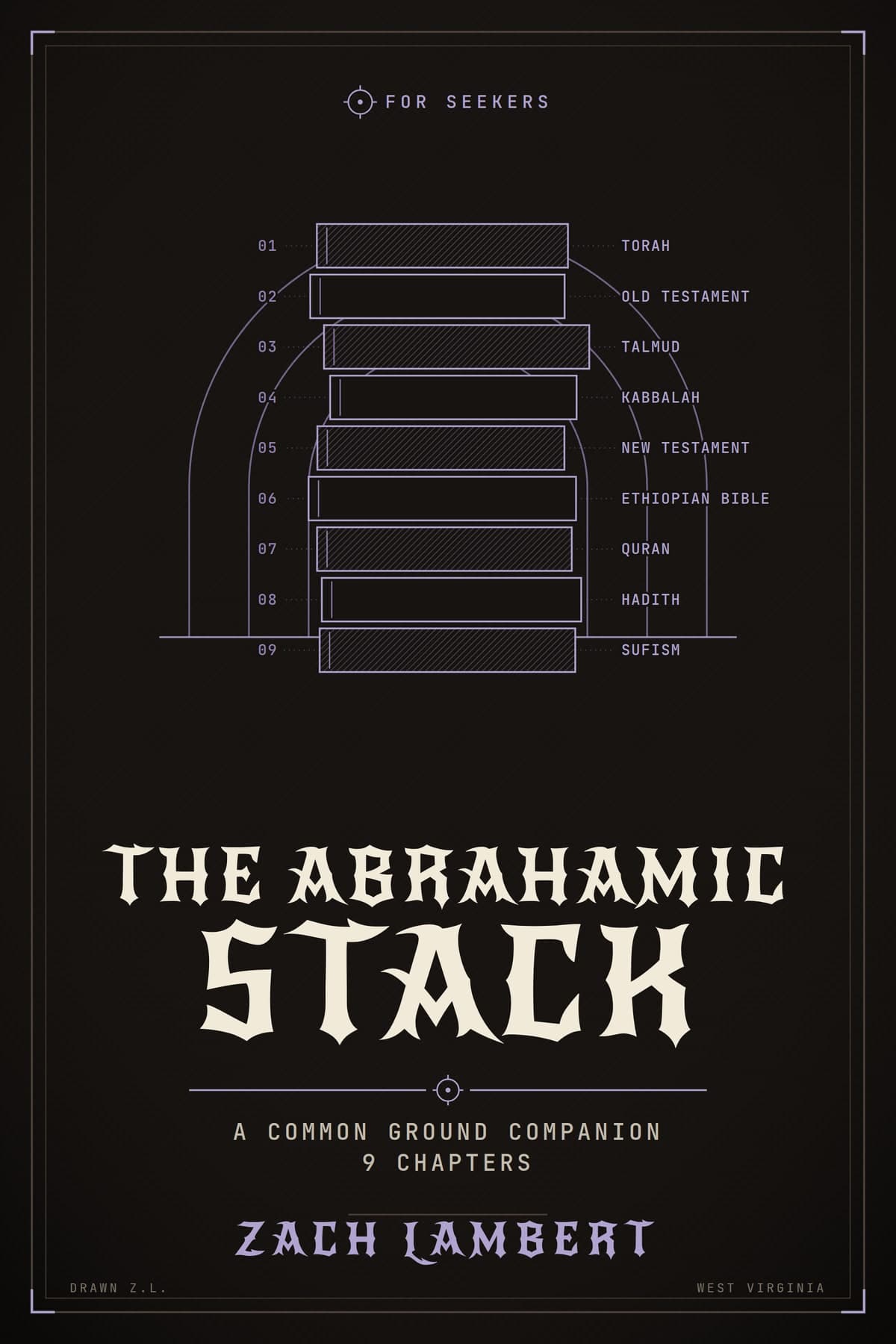
The Abrahamic Stack
9 chapters · $7.99
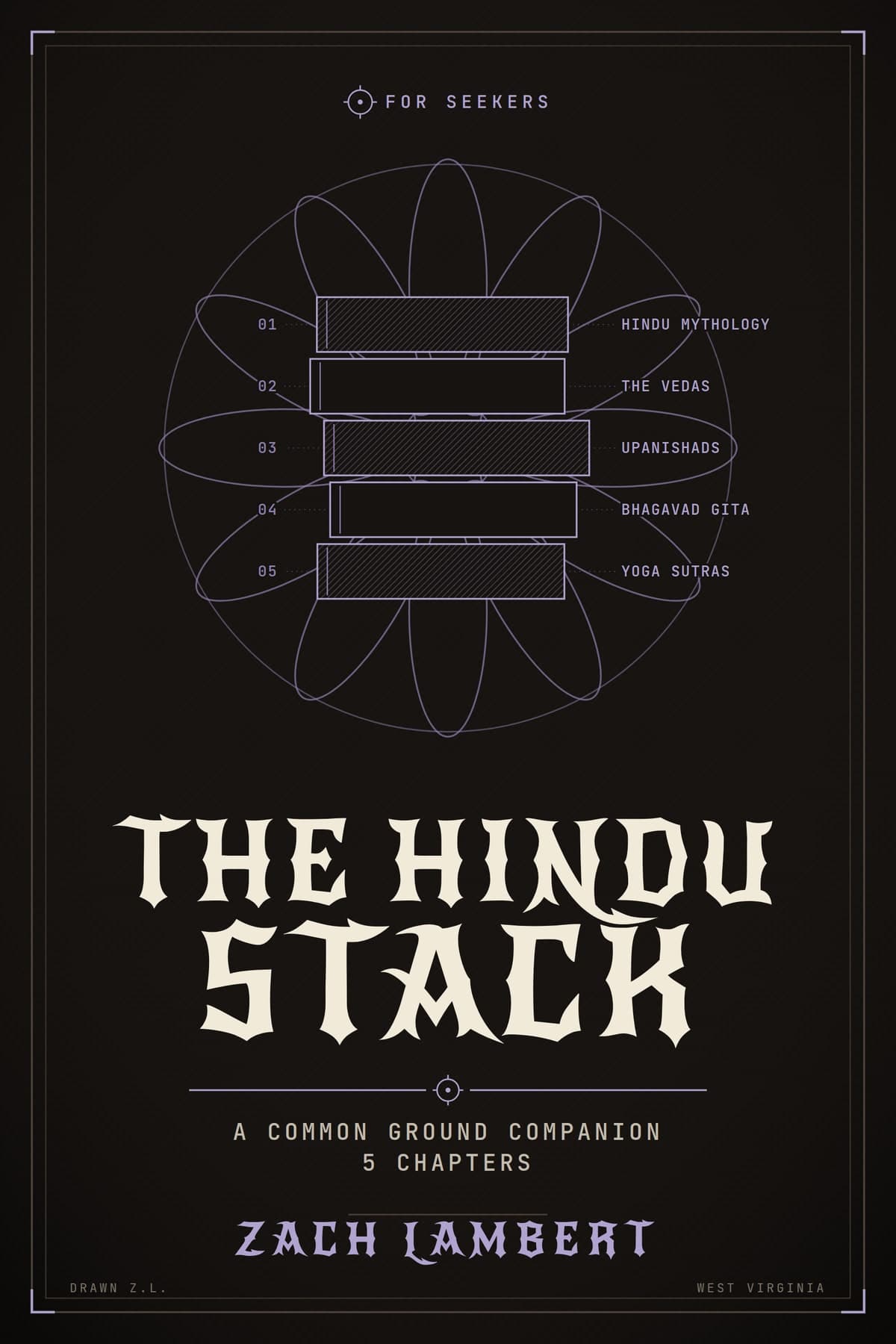
The Hindu Stack
5 chapters · $7.99
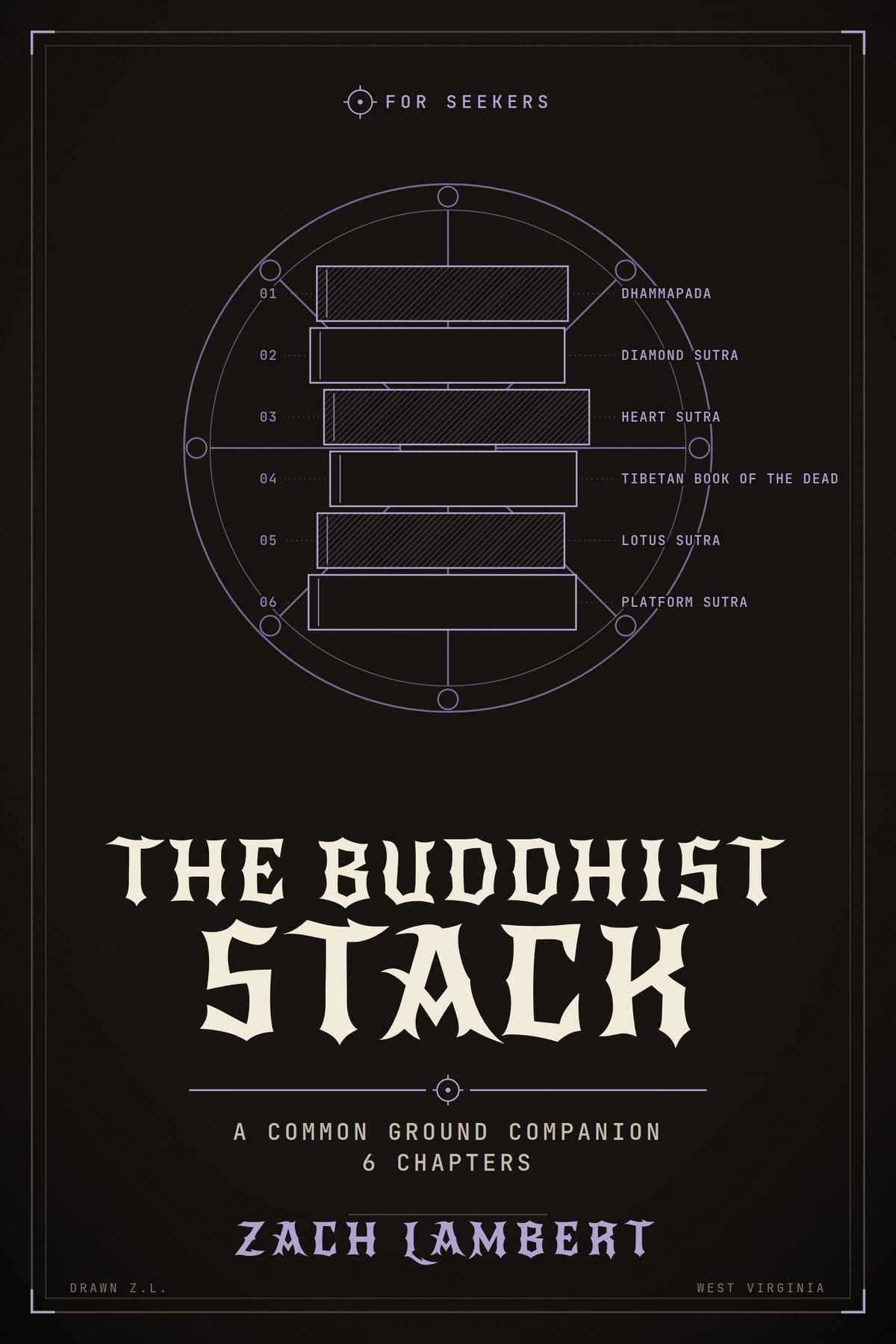
The Buddhist Stack
6 chapters · $7.99
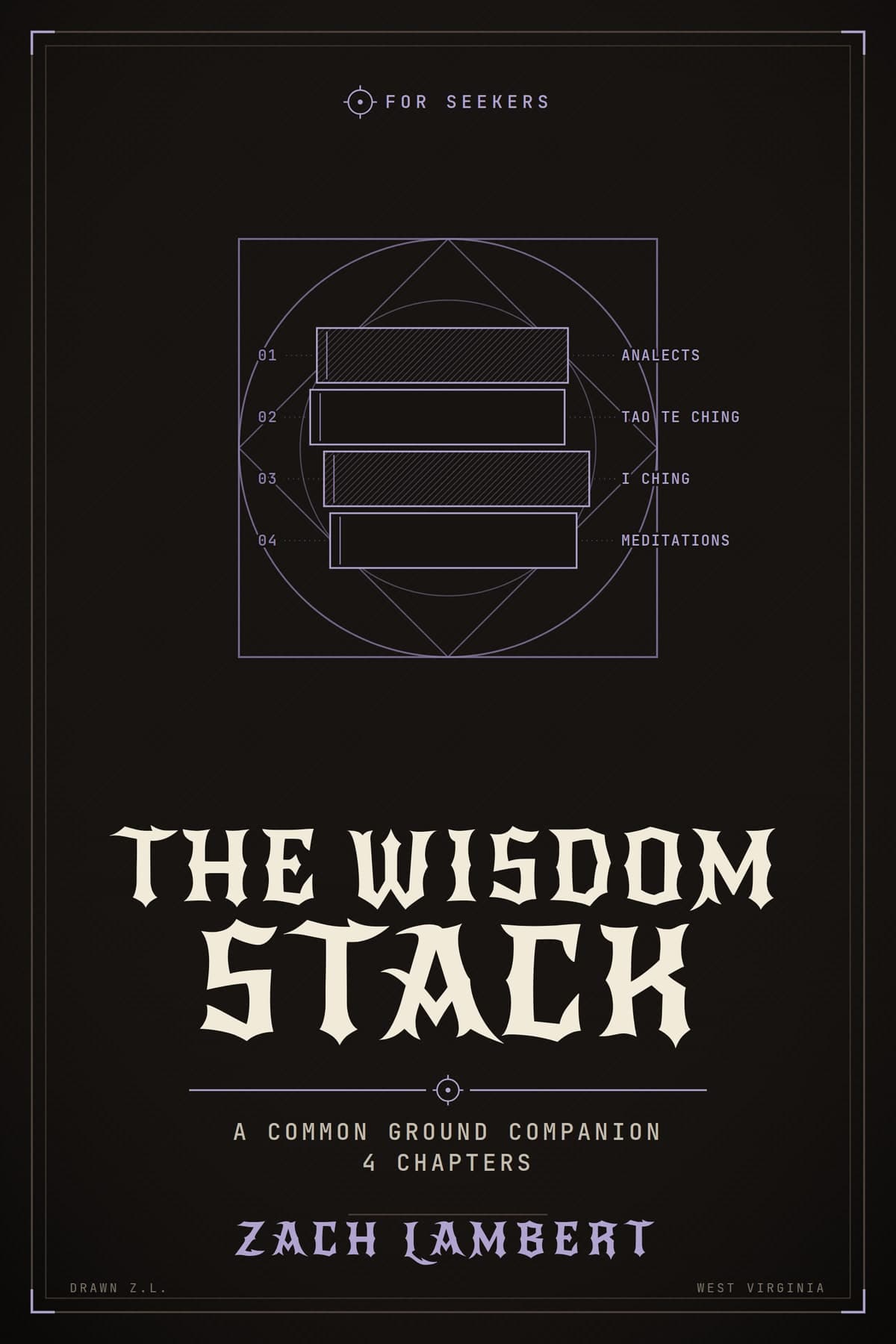
The Wisdom Stack
4 chapters · $7.99
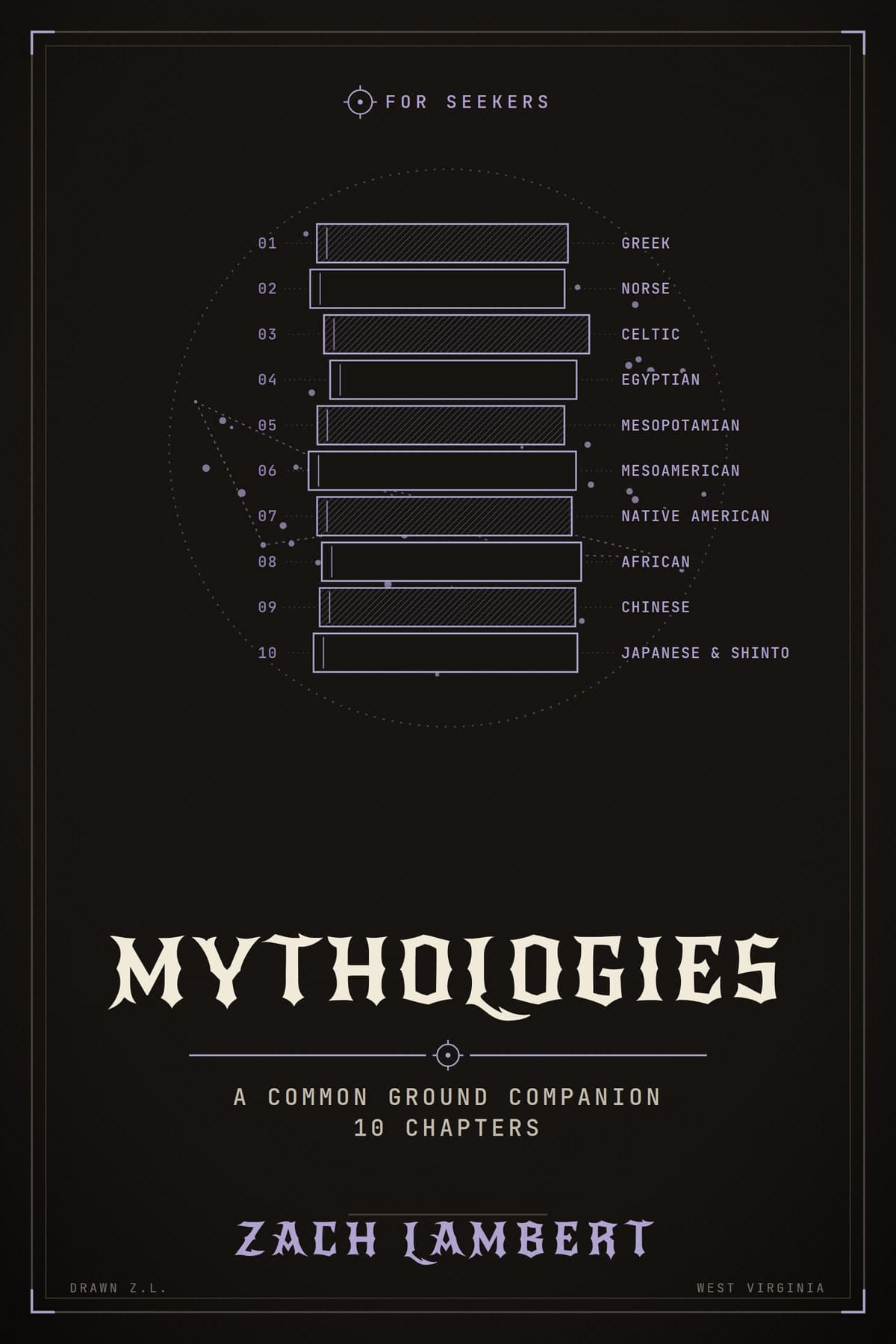
Mythologies
10 chapters · $7.99
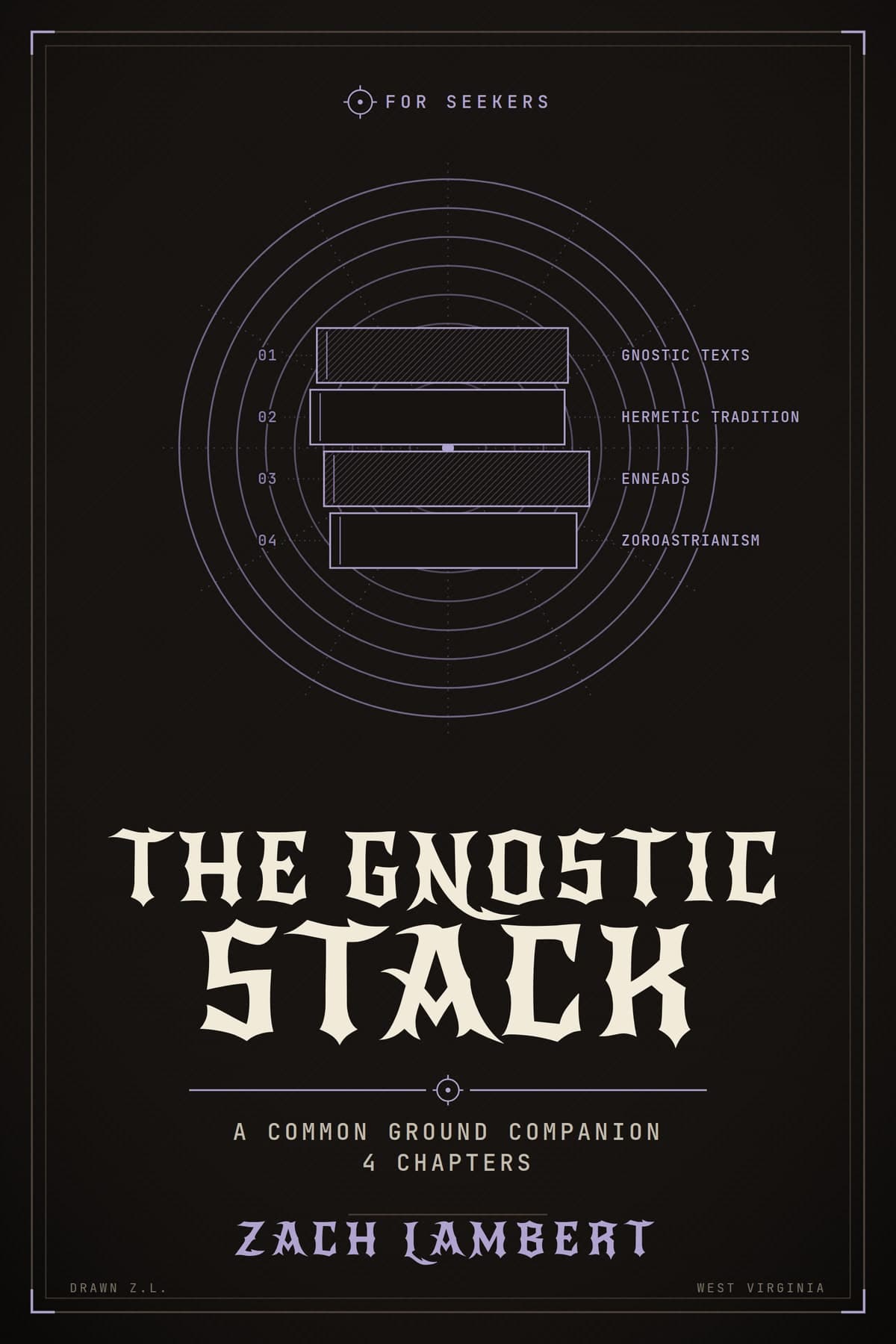
The Gnostic Stack
4 chapters · $7.99
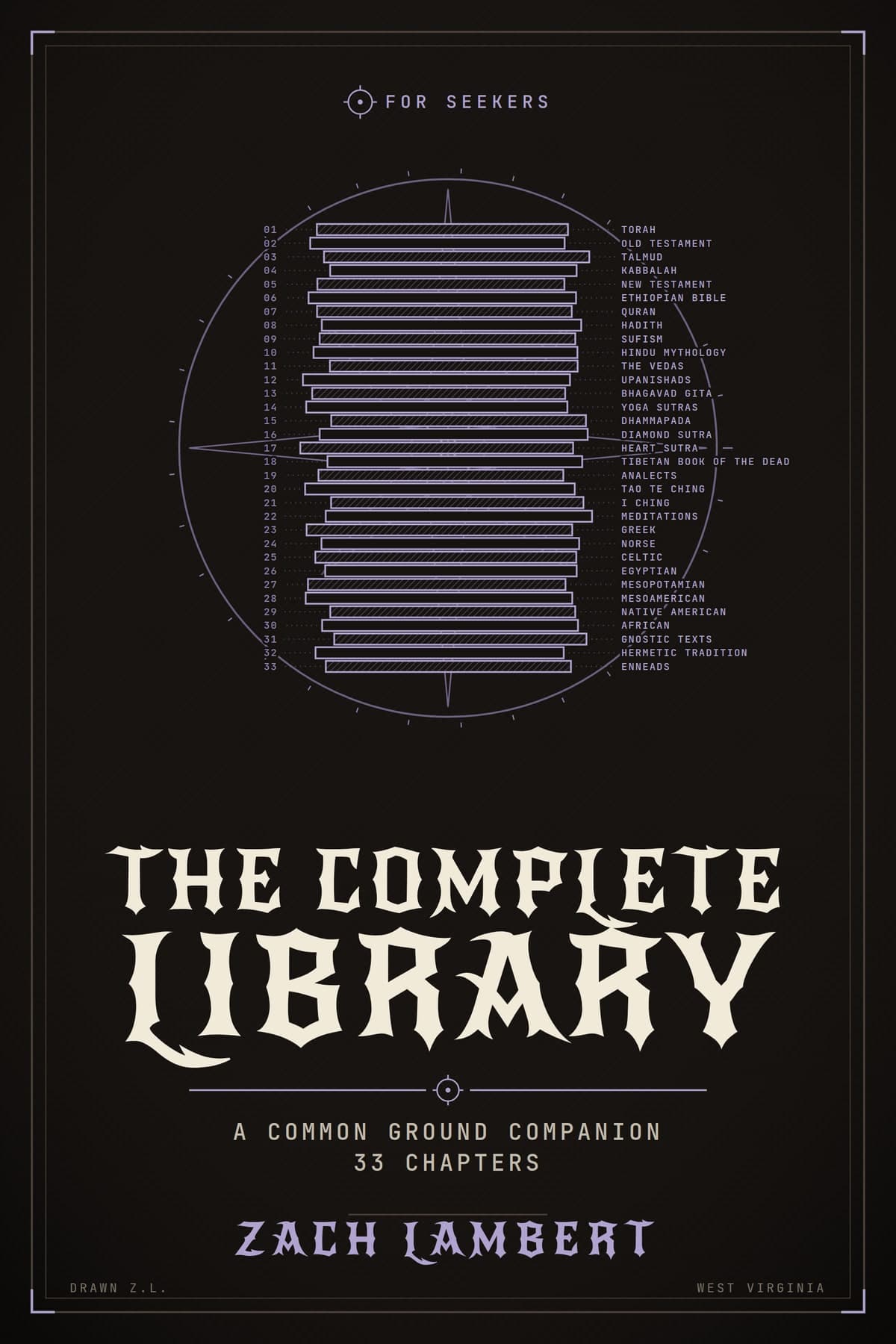
The Complete Library
33 chapters · $9.99
Available on Amazon soon
Common Ground, Volume 2 — Final Read-Through
Don't Be a Dick
The book is written and the chapter order is locked. It's in a final read-through before it goes up on Amazon.
“Every religion's saying the same thing. Somebody just needed to say it plain. Don't Be a Dick — one rule, thirty-one sacred texts, zero seminary Greek.”
Turns out the world's major religions have been arguing about the same thing for three thousand years — just in different accents. This book strips the ceremony off and gets to what's actually underneath: svadharma and “find work you love,” hamartia and “I missed, I'll aim better,” jubilee and just not letting people drown in debt. No pyramid, no revelation, no new religion. Just a working ER nurse from West Virginia who read all thirty-one of the source texts so you don't have to, and came back with one rule that covers most of it. You already know this one. It's on the mug. Clear the tutorial first.
Structure — a level progression
- Prologue — “The Instruction Manual”: the game/tutorial framing, no religious background required
- Tutorial — “Don't Be a Dick”: the one rule everything else is gated behind
- Identity/alignment — svadharma, missing the mark
- Training arc — wilderness, the mountain, jubilee
- Dealing with others — hospitality, the jester lineage, naming/language
- Credibility/method — canon, ceremony vs. crossing, why it's written down at all
- Endgame — death, peace vs. fear at the threshold