The Grafton
No fluids, no power — a 3D-printed, panelized liner inside a cedar box, sealed and foam-filled. The only capital cost to open the whole product line is a ~$150 consumer FDM printer.
Why the name
Named for the Grafton Monster, a West Virginia cryptid famous mostly for how hard it was to actually hunt down. A cooler built to outlast and outperform anything with a name-brand logo on it earns the comparison honestly.
The build sequence: print the shell as individual panels sized to whatever build plate is on hand, snap them together on the Ogopogo dovetail connector standard, then seal every seam watertight. The cedar box is the structural exterior; the printed liner sits inside it, with foam insulation filling the cavity between. Leather strap hardware and copper trim replace injection-molded plastic clips and stainless.
Tier Ladder
- Settler — Day Cooler: 20–25 qt, single printed panel set, minimal cedar shell, 2–3 day ice retention.
- Homesteader — Camp Cooler: 45–55 qt, full MM cladding, leather corner straps, 4–5 day retention.
- Foreman — Field Cooler: 65–75 qt, reinforced lattice ribbing, copper corner guards, 6–7 day retention.
- Monticello — Homestead Cooler: 100–125 qt, dual-hinge lid, integrated axle/wheel option, 8–9 day retention.
- Mythic — The Grafton: 100+ qt, UV-stable liner pursuing IGBC bear-resistant certification, cast bronze hardware, 10+ day retention.
Technical Specifications (Foreman tier baseline)
- Liner: 3D printed, panelized, dovetail-connected (Ogopogo connector standard)
- Insulation: closed-cell foam-fill poured into the cavity between liner and cedar box
- Ice retention: 6–7 days at ambient — matches the upper-mid premium cooler class
- Fabrication: consumer-grade FDM printer (~$150 entry point), sliced from MM's panel file library
The Panel File Library, For Real
The Foreman-tier 65 qt liner sized for a stock Ender 3 — every wall, cap, and corner post it takes to build the whole thing. Every one of these is real, generated CAD, not concept art: modeled from the box's actual 24"×12"×13" internal dimensions, verified panel-by-panel and seam-by-seam so nothing here is a guess dressed up as a part.
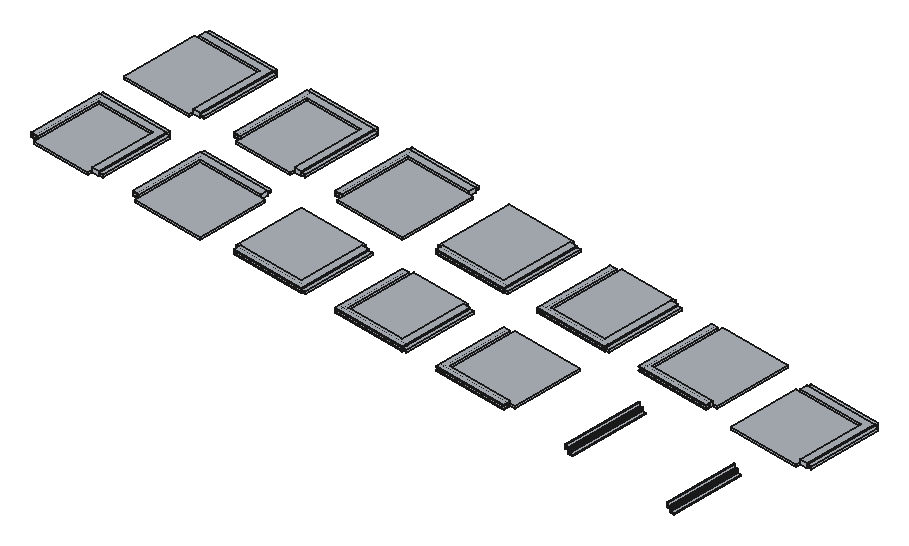
That's not 72 different files — the same handful of shapes tile the whole box: 6 wall-panel shapes (front/back use all 6; left/right reuse 4 of them), 6 cap shapes for the top and bottom, and 2 corner-post shapes that join everything at 90°. Print each shape as many times as its position calls for.
Redesigned Build (2026-09-13): Post-and-Panel Construction
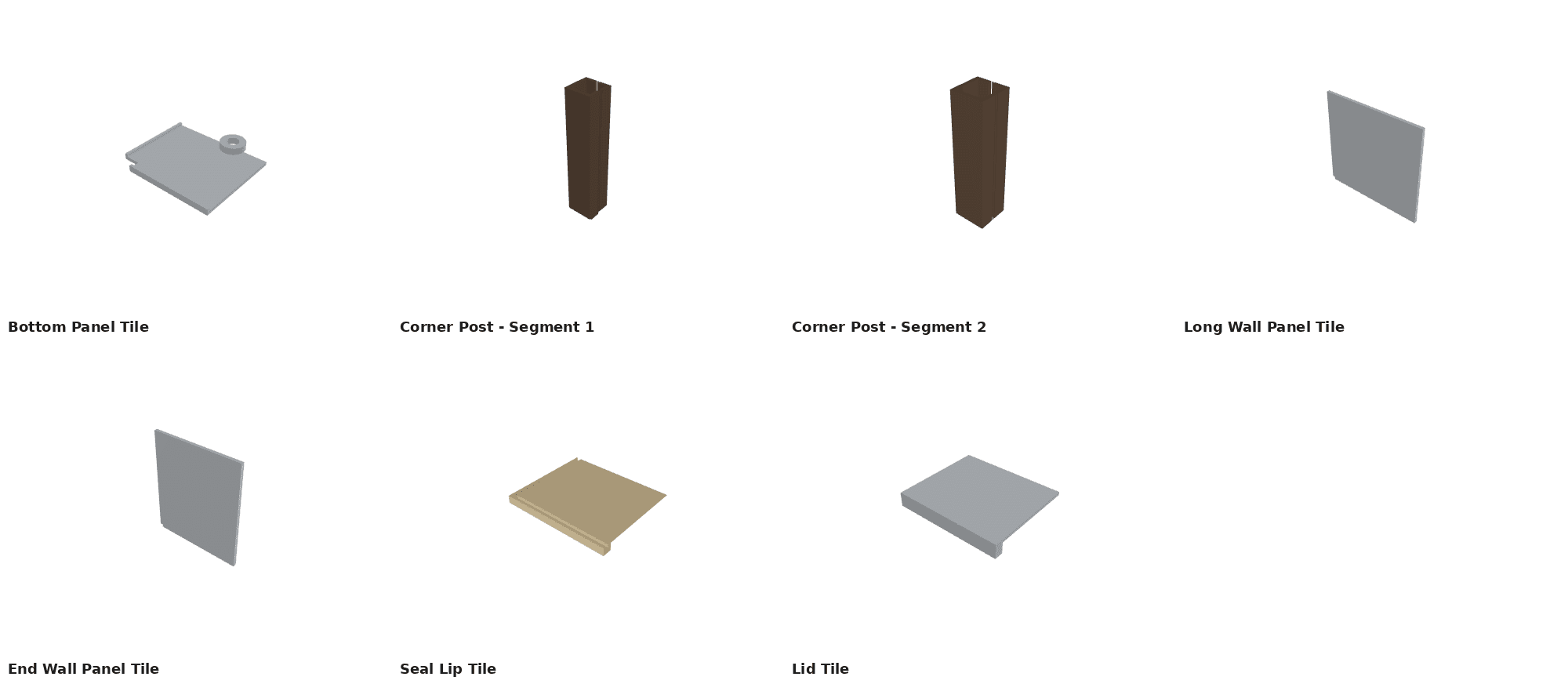
A second construction approach, worked out for increased strength and easier assembly than the dovetail-panel liner above: ASA corner posts (ribbed, hollow, scarf-jointed for tall prints) at all four corners, with PETG wall/bottom/lid panels tiled to fit the print bed and tongue-and-grooved together. Corner posts carry the structural load in a tougher, UV-stable material; panels stay in the easier-printing PETG since they're not doing the same job. This is a fresh CAD draft, not yet run through the same panel-by-panel interference verification as the design above — treat it as an in-development alternative for now, not a replacement.
Specialist Sign-Offs Required Before Construction
- Print settings and material validation — food-safe filament choice, wall thickness and lattice density tuned per tier, seam sealant validated for waterproofing and food safety
- IGBC bear-resistant certification testing — Mythic tier only, third-party lab testing required
Open Items
- Panel file library not yet built — needs a range of panel sizes for different printer bed sizes
- Epoxy/sealant product choice for liner seams not yet tested for food-safety and long-term water exposure
- IGBC certification timeline and cost for the Mythic tier not yet researched