The Uktena
Every MM roof is already standing seam metal — the best catchment surface there is. This line doesn't add infrastructure, it captures what's already hitting the roof, in a terraced cistern cascade.
Why the name
Named for the horned water serpent of Cherokee legend, said to live in deep pools and control the flow of Appalachian rivers. A system built to control every drop that hits the roof, right down to the last overflow, isn't reaching with the comparison.
Flow path: standing seam roof → copper gutters and leaf diverters → a first-flush diverter that dumps the dirtiest initial runoff → a cascade of storage tanks following the property's existing terracing → staged filtration (coarse screen, sediment, carbon, optional UV) → gravity-fed distribution where terracing allows → overflow routed to the food forest instead of wasted.
Tier Ladder
- Settler — Single Barrel: 50–75 gal, one downspout, garden irrigation only.
- Homesteader — Cistern Pair: 500–1,000 gal, coarse + sediment filtration, household non-potable use.
- Foreman — Terraced Cascade (Greenbrier spec): 2,500–4,000 gal across 3 tiers, coarse/sediment/carbon filtration with optional UV.
- Monticello — Whole-Property Cascade: 8,000–12,000+ gal, full potable treatment train standard, ties into the hearth's hot water loop.
- Mythic — The Uktena: 15,000+ gal, full multi-structure catchment, redundant filtration, fully pressurized with gravity-fed emergency backup.
Technical Specifications (Foreman tier baseline)
- First-flush diverter: multi-zone, roughly 10 gal diverted per 1,000 sq ft roof per 0.1" of rain
- Filtration: coarse screen → sediment → carbon; UV optional at this tier
- Storage: gabion-clad tanks, one per terrace tier — food-grade poly liner standard, geopolymer optional upgrade
- Capacity: 2,500–4,000 gal across 3 terraces
Specialist Sign-Offs Required Before Construction
- Structural engineer — a 1,000 gal tank is over 8,000 lb of water alone; terrace and gabion wall loading needs verification
- Potable water treatment specialist — required at Monticello+ tiers or if the UV stage is activated at Foreman tier
- Local code compliance — WV rainwater harvesting regulations, backflow prevention if any potable/cross-connection use is planned
Uktena Fang: First-Flush Diverter (2026-09-13)
A real gap in the catchment system: standard first-flush guidance is to divert roughly 10 gal per 1,000 sq ft of roof, but a single vertical standpipe can't hold that within a realistic gutter-to-grade drop (the math needs ~15 ft of 4" pipe for a 1,000 sq ft roof — most homes only have 8–10 ft of drop available). The fix is a manifold of parallel standpipes instead of one tall one: volume scales with pipe count, not pipe height, so it fits under a normal gutter. A downspout adapter transitions the rectangular gutter downspout into the manifold header's round inlet; the header splits flow into N standpipes (the script computes the count from your actual roof area); each standpipe has its own removable end cap with a small bleed orifice, draining slowly to the mulch bed and resetting capacity before the next rain. Once all standpipes are full, water backs up in the header until it reaches the overflow outlet, then continues on to the tank.
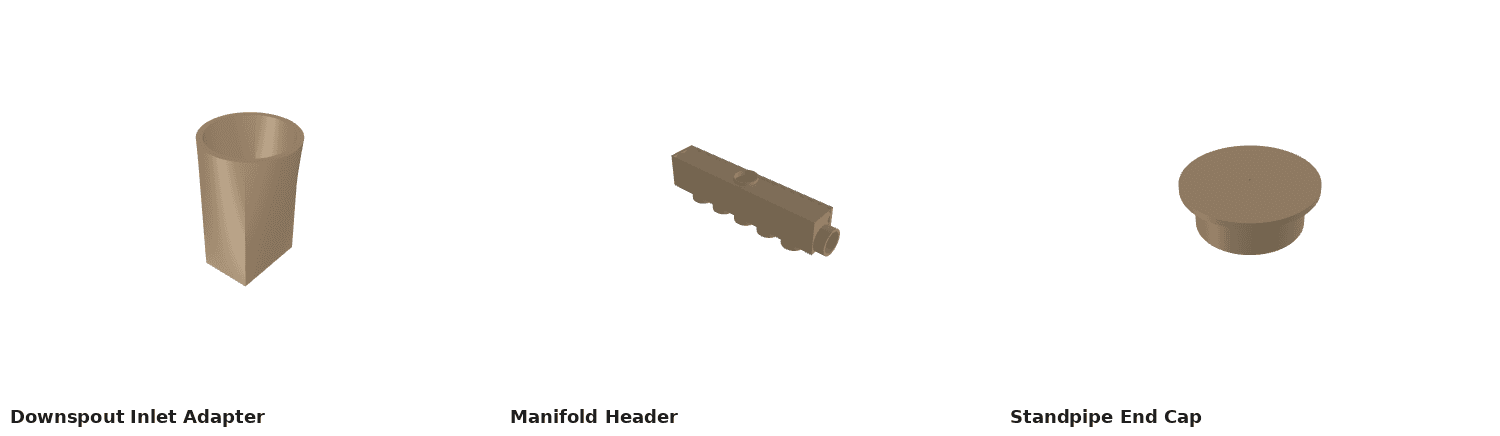
Scales down cleanly for smaller catchment (a shed or greenhouse roof): the same header design just computes down to a single standpipe, not a separate build.
Open Items
- Overflow/recharge basin design not yet specced for Monticello+ tiers
- Potable treatment train components (UV vs. ceramic vs. both) not yet chosen
- Integration point with the Great Hearth's water coil needs a plumbing pass to confirm hot/cold loop separation
- Uktena Fang bleed-orifice size (3mm starting point) needs real drain-time testing, not just the calculated first-flush volume